
How Prosthetics in Sports Are Changing the Game
 by Richard Janvrin,
December 25, 2025
by Richard Janvrin,
December 25, 2025
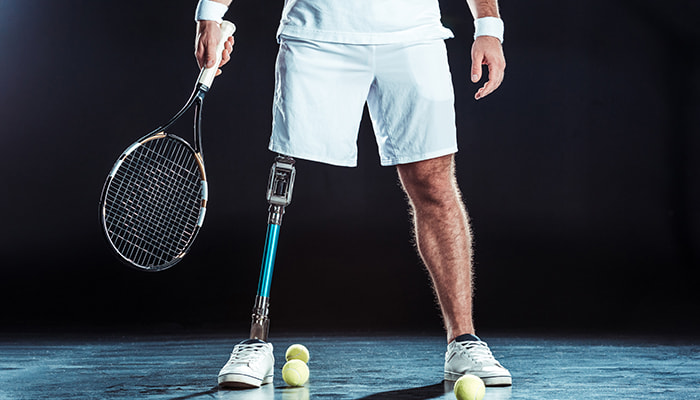
In the modern day, one of the first instances we’ve seen of prosthetics in sports was Dick Traum, a runner who competed in the 1976 New York City Marathon with a prosthetic leg.
Leading up to that, prosthetics had been used in various forms throughout history, but since then, prosthetics have come a long way, allowing athletes to succeed.
One of the most notable examples was double-amputee Oscar Pistorius during the 2012 Paralympics. If sports betting apps were around then, I’d be curious to know what his betting odds would’ve been to win the T44 400m Final.
With that said, below, I’ll explore the advantages of prosthetics in sports, the disadvantages of prosthetics in sports, the future of prosthetics in sports, and more.
- Advantages of Prosthetics In Sports
- Disadvantages of Prosthetics In Sports
- The Future of Prosthetics in Sports
- Example of Sports that Use Prosthetics
- A New Era of Athletic Potential?
Advantages of Prosthetics In Sports
Regardless of whether you’re an athlete with or without disabilities, sports can be life-changing for people, whether that’s going on to make generational wealth as a professional or to build a community of people who enjoy spending time with. This alone is one of the biggest advantages of prosthetics in sports.
These provide players with a chance to compete at the highest levels possible by enabling mobility and allowing them to compete against one another. When designed correctly at the highest level, these prosthetics will allow you to run, jump, swim, and throw.
Thus, we’ve seen events like the Paralympics, which allow athletes from all over the world facing similar trials and tribulations due to disabilities to compete against one another.
Moving beyond just the general feeling and inclusiveness, there are also excellent mechanical/engineering benefits, such as single or double-amputee long-distance runners exerting less energy, which helps them maintain their speed.
Overall, these prosthetics help athletes reach new heights and serve as a great source of inspiration for everyone, regardless of whether they have a disability or not.
Disadvantages of Prosthetics In Sports
While there are advantages, there are also disadvantages of prosthetics in sports. Another way to view these could be limitations, too.
Of course, no prosthetic will ever be the same as a natural limb. While the carbon-fiber blade legs used by runners can reduce overall energy expenditure, they do have a slower start off the line and aren’t as stable as a leg would be.
Additionally, while prosthetics can allow you to play various sports, there are some limitations in sports where you have to make quick cuts or change direction, such as basketball, soccer, or even football, as the prosthetics won’t allow you to respond as naturally, precisely, and quickly as a natural limb.
Something else to consider is that athletes can’t feel the ground or the ball (if playing soccer), so there’s no sensory feedback.
Beyond just what it’s like on the field, track, court, or pitch, there are also financial implications. Having cutting-edge, high-performing prosthetics to compete at the Paralympics or another major stage isn’t cheap.
A single running blade, for example, can cost into the tens of thousands of dollars, which limits more athletes than not. There may be insurance plans that assist, but these can often involve out-of-pocket costs.
Thus, athletes with disabilities may need to look to scholarships, grants, or charities to help cover the costs of these so they can continue competing.
Sports prosthetics can provide a new lease on life for some, but the financial component does limit things. Whether fair or not, that’s simply the reality of the situation right now.
There’s also something to be said about the fairness and regulation. There’s plenty of conversation about prosthetics that provide abilities beyond what a natural limb could even achieve.
There are often regulations from the appropriate governing body requiring proof that certain prosthetics don’t enhance a person’s natural abilities.
So, in addition to some limitations, there’s also a discussion of the financial implications and, in contrast to limitations, some enhancements.
Example of Sports that Use Prosthetics
There are numerous sports in which prosthetics can and have been used. While these can be used for most sports in various capacities, here are some that we’ve seen them have the most success:
- Track & Field: Sprinting is a common event at the Paralympics for single or double below-knee amputees. As mentioned before, Pistorius had success at the 2012 Paralympics.
- Cycling: Athletes with prosthetics for their arms or legs can participate in this sport. There can also be attachments to help secure the athlete on the bike.
- Swimming: Special prosthetics are available for low-impact swimming.
- Other Sports: Prosthetics have been successful in other sports, such as archery, golf, and even weightlifting. Golf and archery aren’t too high-impact, and they could be a bit more accessible because they don’t always require the best-of-the-best prosthetic running blades.
The Future of Prosthetics in Sports
As with other technological advancements, over time, prosthetics in sports will only get better as researchers, engineers, and designers march toward making these artificial limbs as close to natural limbs as possible, if not better.
Beyond the carbon-fiber running blades, some robotic prostheses with motors and microprocessors move even better.
Believe it or not, there may come a time when an amputee could play a high-level basketball game. There could someday be a prosthetic that pushes off the ground and adjusts in real-time to best fit the runner’s start, for example. These could also adjust to certain terrains.
Something else to keep in mind is 3D printing, which could help make future prosthetics more accessible to those who may not be as financially well-off as to afford the tens of thousands of dollars out of pocket for prosthetics. This will only allow more people to compete, creating a larger pool of athletes to strive for greatness.
A New Era of Athletic Potential?
While there may be disadvantages or limitations, prosthetics have opened the door for people to still participate in the sports they love. Prosthetics in sports may not be perfect now or may never truly be a 1:1 replacement for a natural limb, but they have not only restored mobility but also allowed athletes to succeed and become a source of inspiration for everyone.
Sports aren’t just for people without disabilities; there are avenues for everyone who wants to compete, whether that’s as a kid, recreationally, or reaching the highest possible levels.