
Do Kids Still Play Sports? How Youth Participation Has Changed Over the Years
 by Richard Janvrin,
December 18, 2025
by Richard Janvrin,
December 18, 2025
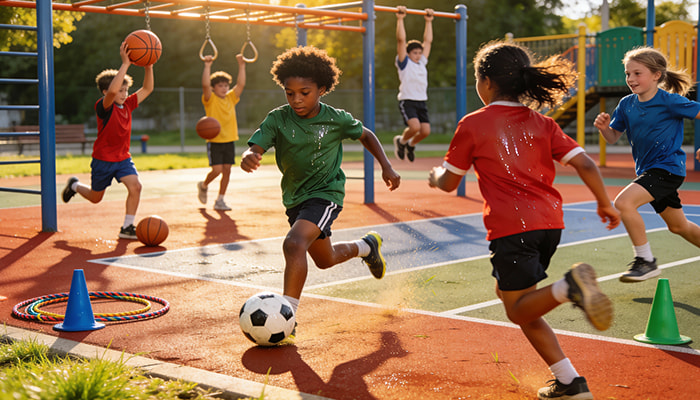
Historically, the most popular youth sports in America have been basketball, soccer, and baseball. That said, while kids flock to these sports as they’re fairly easy to pick up and play, things have been changing.
According to ZipDo, about 45 million youths and adolescents play organized sports in the United States per year, which is about 60% of that dataset.
Below, I’ll examine other youth sports participation statistics, explore what percent of kids play sports, and more.
- Youth Sports Participation Statistics
- The Most Popular Youth Sports in America
- Youth Sports Industry Statistics
Youth Sports Participation Statistics
As mentioned, 45 million youth and adolescents play sports today. At a 60% rate, it’s clear that sports are still a big part of childhood.
However, there was cause for concern in 2022: 53.8% of kids aged 6-17 played sports, down from 58.4% in 2017, according to a study.
Also during that span, younger kids were more involved in sports, with 55.7% of kids aged 6-11 playing in 2022, compared to 52.1% of kids aged 12-17.
Not only that, girls also played less than boys did. Boys accounted for 58.1% in 2022, while girls accounted for about 49.4%.
This answers the question, “What percent of kids play sports?”
There was another interesting dataset showing that 70% of kids quit sports by 13, which also helps answer another question: “How many kids play sports?” This could be due to a variety of factors, including time, cost, and the level of competition.
Here’s ZipDo’s interpretation of that kind of data:
“While youth sports foster confidence and leadership in many children, with half exploring multiple sports and volunteer coaches keeping the spirit alive, a staggering 70% of young athletes drop out before adolescence—highlighting that amid hours of practice and fleeting ambition, the true challenge lies in sustaining lifelong love for the game beyond age 12.”
Something worth noting in the dataset for 2017 to 2022 is that the pandemic was smack dab in the middle of that period. In 2021, only 37% of kids aged 6-12 played sports due to canceled seasons and general disinterest amid potential exposure to the virus.
This also affected high school kids, as 49.1% of high school students played in 2021, the lowest rate in the 21st century.
So, between overall burnout, the pandemic, heightened competition, costs, and general interest, kids are seemingly leaving sports behind as they get older.
The Most Popular Youth Sports in America
Right now, the most popular sports among kids are basketball, soccer, baseball, and softball. Surveys have found that 37% of kids play basketball, 26.5% play soccer, and 24.1% play baseball/softball.
Other sports like volleyball have also seen some growth, coming in at 11.9%.
So, what are the most popular youth sports in America? Basketball, soccer, and baseball/soccer.
Youth Sports Industry Statistics
Moving beyond youth sports industry statistics like who’s playing, there’s also the business behind it.
In the United States, youth sports is a $19 billion industry (as of 2022), which is even higher than the NFL.
“A $19.2 billion market in the US, means the youth sports market rivals the size of the $15 billion NFL. Youth sports markets are comprised of segments that represent revenue generation from travel, equipment, team membership, facility construction, software, and venue rental. Leagues who purchase and distribute sports software to teams or clubs have created a large market from what were previously disparate parts of what was not ever not even a market, just people buying clothes and equipment, and loosely organized groups of youth playing games on community fields,” Globe News Wire wrote.
In 2019, a study by Wintergreen Research, Inc., which was 296 pages and had 130 tables and figures, suggested that the market could reach $77.6 billion worldwide by 2026.
“Market growth comes from increased benefits of organization in youth sports leagues. Travel teams and tournaments are in vogue. This is a nascent market, there is no end to growth in sight. Markets are expected to reach $77.6 billion by 2026. Youth sports teams will continue to get more organized and depend on software to provide increased management efficiency. Video images of play will provide better coaching,” Globe News Wire also wrote.
The industry includes leagues, tournaments, apparel, travel, and equipment, which results in a lot of jobs in this field, including hundreds of dollars spent on gear.
According to Jersey Watch, parents spend, on average $883 per child per year on youth sports.
This was also found to be north of $1,100 for basketball, which is one of the most popular youth sports in America. This industry doesn’t include top basketball sportsbooks either, as you cannot legally wager on youth sports.
Thus, we’ve seen youth sports take a more fun approach rather than competition to help keep kids involved.
The focus is now more on skill-building and fun than simply winning.
“While half of youth sports programs now prioritize fun and skill-building over fierce competition—and a growing number address mental health and sustainability—the pressing challenge remains funding, yet those embracing life skills see a notable boost in satisfaction, highlighting that holistic development is the winning game,” ZipDo wrote.
Today, youth sports are still popular, but things are changing. While youth sports participation statistics dropped due to the pandemic and kids generally stopped playing by age 13, the rate is back up to 60% for all kids and adolescents. These youth sports industry statistics show that things are only getting better as time goes on and we move further away from the pandemic.